The images of The Adytum allude to
traditional depictions of the virtue of the power of the mind over the body.
Recalling the death and the maiden motif made famous by Hans Baldung's
woodcuts, together with images of dark, church-like interiors, the prospect of
a morality tale insinuates itself. As a skeleton beckons a young woman, the
film’s protagonist, Kloeshi, the viewer is set up to anticipate judgment and
retribution. Perhaps the young woman suffers from vanity or lust, afflictions
or "sins" that result with the power of the body over the mind.
Through the economy and tradition of cultural images, the viewer is immediately
given over to caution, even suspicion towards the skeleton who surely
symbolizes death, the greatest unknown. For with the image of the skeleton we
see a human spirit separated from its corporeal vehicle.

The
skeleton befriends Kloeshi, even teaches her music and language, inviting her
to learn love as she develops tools to empower herself against opposing forces.
The glorification of the character comes not through themes of body over mind
as a reaction to mind over body, but simply through curiosity, improvisation
and artistic self-making. She defines herself gracefully through external and
internal contemplation and makes a gestalt of her suffering. The friendship
with the skeleton reveals the sincerity of her bond to her own inner structure
as she makes sense of the external structures. At the same time a sense of
foreboding follows the skeleton’s gentle “come hither” gesture, which become
more violent as the corrupt monk and the power structures of her actual
circumstances confront her.

While it is appropriate to associate the
image of a skeleton with death, I think it is inappropriate to associate death
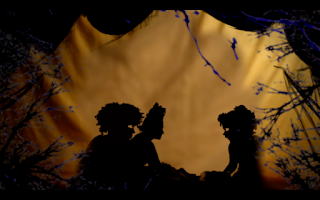
with immorality or retribution. The recognizable form of the skeleton,
specifically in silhouette, reveals the seductive element of mystery in death.
In both the case of religious ethics and Socratic ethics, the demonized element
embodied by the human skeleton is simply that which remains unknown. Through the lens of
Christianity, the locus of the demonized unknown is within our own body. R
Joseph has described the role of the limbic system in human spiritual
experience with various historic examples documenting human "out of
body" experiences. Astral projection in Buddhist religious practice,
measures to a great degree, the success of meditation. Much of religious
experience, the closeness to God is associated by the individual's feeling that
they are "outside" their body, an implication of the temporal lobe, a
facet of the limbic system in the human brain. Meanwhile, through the lens of
the Socratic tradition, what we learn through reason is made knowledge when we
internalize it by expressing it consciously. That which cannot be committed to
consciousness through reason is unknowable. Therefore, the locus of the
demonized unknown in the Socratic tradition is outside the body. In both
instances the body creates a conflict with relation to human understanding. We know either by that which is empirically
observed through our bodily senses or by
that which can only be experienced as emotion, and insufficiently described by
language.
When
the child, Kloeshi meets the skeleton, she is only as hesitant to interact with
him as any other stranger. As he gains her trust he leads her downward into a
setting of organic patterns and ambiguous primordial matter. A moralist
standpoint might point out that he is leading her metaphorically downward to
her demise, to hell even, but there is no fire where the skeleton leads
Kloeshi. There are only instinctual memories of an era before humanity. The
imagery traversed by Kloeshi and her guide changes seamlessly from a
recognizable landscape including objects recognizable as trees and sky to what
feels more like being inside the body. It is here that the character is most
deeply connected to her instincts and unconscious, but simultaneously where she
is most divorced from the objective world. Out of balance, she is vulnerable to
others’ power in the same way the smallest animals are vulnerable to predators.
The silmultaneous interaction between the masked Kloeshi and the intruding monk
and the silhouetted Kloeshi and the skeleton are purposefully chaotic and
confusing, for ultimately, when a predator overpowers its prey there is at once
an individuation of ego and a unification of two beings. In this moment, while
the monk hovers in the dominant position, his physical size shrinks while the
cowering shape of the child grows as she struggles against it. There is no
clear winner or loser in this exchange of power, but there is a climactic
effect. There is an epiphany that there is more than one way of viewing the
world.
Towards
the end of the film, the actress’s feet are seen at a white dress drops to the
ground and she steps out of it. I intended this image, not as the loss of
innocence, which is one way it could be interpreted, but rather as the removal
of idealism.
Again at the film’s closing, I completed
the theme as the actress removes the mask staring directly at the camera.
Similar to the mask she has worn throughout the piece, her face lacks
expression. She might be suffering but she no longer needs the mask to guard
her from the difficult lessons she had to learn through experience and chaos. The
music is what gives the meaning to the unfolding of events. A slow, meditative
musical texture carries us to the final fade to black. She no longer remains
idealist but neither does she remain ignorant of the chaos of human experience.
Removing the parody of her real face, she becomes fully human.


In creating this film, I employed a great
deal of planning that I had to relinquish to the chaos of collaboration. I
chose both actors and musicians as collaborators and all of them were people in
whom I put a great deal of trust. In this way, I invited them into my adytum
and gave some control away to allow for Nietzsche’s Dionysian force. In art, Nietzsche described the Dionysian element
of art as the chaos of improvisation; the musical force that causes us to lose
our individual egos in the undulation of group chorus or dancing. The
Apollonian force applies structure to art and we then see beauty in logic. As
we have become more logical, symbolic and scientific as a nation, we come to
see the chaos described by Nietzsche as “the spirit of music” as a primarily
negative force that threatens the beauty of logic and structure. What results
is an over-evaluation of literal elements, lyrics, and formal symbols. In film,
this is manifested as the “linear” format, where a story unfolds in sequence
and each plot point hinges on the previous. When we set ourselves up to view
film this way, we behave the same way we do when we engage in formal debate. We
look for plot holes and other elements that are logically amiss. Our willing
suspension of disbelief has become extremely contingent and our society watches
movies with the expectation that every visual event follows strict logic. In response,
filmmakers provide love stories so ideal we feel lied to; or perhaps more
realistic explosions, which cost more money, because that kind of documented
destruction requires multiple takes. To me, modern
cinema shows the imbalance of Western culture. I look to Eastern European filmmakers
to break this trend.
In
the works of Russia’s Andrei Tarkovsky, the seamless movement between dream and
consciousness comes as easily as the slow shots as the camera glides across the
action of his long cuts. His subject matter is lonely and contemplative, often
prolonged to the point of antagonizing a less patient audience. However, art
and viewer form a relationship. When I regard the slow honest beauty of
Tarkovsky’s Nostalghia or The Mirror, modern American cinema as a
whole feels like a one-night stand or a speed-dating convention. This is not to say that there is no art
in modern American cinema. There is art, but a director, like any politician,
must dance around the boundaries of what is currently socially acceptable. Film
is still a relatively young art form, emerging with technology in a time when
women were extremely marginalized. Could the popularity, even the perceived authority of the linear format, mirror
the minds of the moguls of this industry?

Biological
anthropologist, Helen Fisher presented her work on the brain in love at a TED
talk and discussed the differences in brain circuitry between men and women. Of
women she says:
"They tend to be web thinkers. Because the
female parts of the brain are better connected, they tend to collect more
pieces of data when they think, put them into more complex patterns, see more
options and outcomes. They tend to be contextual, holistic thinkers, what I
call web thinkers. Men tend to -- and these are averages -- tend to get rid of
what they regard as extraneous, focus on what they do, and move in a more
step-by-step thinking pattern. They're both perfectly good ways of thinking. We
need both of them to get ahead." (Fisher,
2006)
With The
Adytum, I wanted to express the way I learn as a woman. Fisher’s
description of female thought as web-like or “holistic” struck a chord with me.
When we see patterns in our lives, particularly those that cause negative
emotions, it seems the most efficient and practical to look for the broken
link, repair or delete it, then continue living. But this logical approach
often leaves us in that same rut, conditioned to seeing the repetition of a
pattern as simply a new, similar but different pattern that we should simply
troubleshoot in the same way. This is not holistic thinking. For me, discovery
and understanding comes with a kaleidoscopic revealing of themes. There is too
much to see all at once and there is not one problem on which everything else
is hinged. In the world, I find that nothing is extraneous, but everything is
part of a larger concern. The goal of science is to help us predict the next
line in a sequence, but the goal of prediction is control, whose ultimate goal
is comfort. Ironically, there is a great comfort in relinquishing that control
and all the associated labors in favor of simply allowing the world in all its
complexity to reveal itself to you.
I
communicated to my collaborators my desire for both documentary and contrived
elements in this piece. As a director, I worked more like a mother and an
organizer, developing the performances of each of my beloved friends based on
what I knew of them individually. Occasionally I filmed them candidly without
their specific knowledge that I wasn’t just setting up. Other times I asked for
something more acted. In every instance, I simply tried to create a situation
that would be comfortable for experimentation and improvisation. I found that working from large themes and
without giving the actors a linear script made me even more open to everyone’s
suggestions. Although the story was mine, I truly felt it was anyone’s story,
and anything I envisioned was easily influenced by the genuineness of what I
could get from my collaborators naturally.
Occasionally the faces of actors are revealed when the two-dimensional
masks facing left or right, need to face the opposite direction. These
accidents are welcomed as small tokens of vulnerability to the viewer, with
whom we tried to negotiate communion. The process, with all its genuine awkwardness
and discovery is evident in the product.
It is because of the era of science that
the adytum of technology has opened its walls to me. I feel a profound respect
for the inventors and manufacturers of tools I have used in creating this film
as well as my fellow artists. Although we are all humans, subject to delusions
of wisdom, we are united in our desire to make sense of our world. By science
or by myth, we continue walking forward to mysterious silhouettes of the past
as they dance on the walls; the seductive shapes of the future.


