Thursday, September 22, 2011

Memories, Dreams, Reflections, Jung, Freud, Nietzsche, and Process

Yesterday I went to the Writing Center for help writing my thesis. I've had little direction on how to go about it or what the guidelines are. I've visited the University's online resources, which would be more helpful if they showed an example instead of a page of words describing pagination... ultimately I find again and again that words of help written by people, are alienated from those people, and that true help is a feeling. Suffice to say, Jennifer at the Writing Center was helpful and I have an appointment to see her again in two weeks.

Though I've been reading from a variety of sources over the last two years, my research has been scattered, non-linear, and the antithesis of efficient. Nonetheless, I can't be ashamed of the process because I've been absorbing information all this time. During my session at the Writing Center, Jennifer suggested I had a lot of research to do. This was a blow to me, because I thought I had been staying ahead with the assortment of self-imposed readings I had done. When I consider what a slow-cooker I am, I forget to look at the other end of that spectrum, the pressure to produce. The Raphael reading made me think in terms of pure planning vs. pure production. Like the anecdote concerning the wall decoration he had no time to plan out with preliminary drawings, I like to wade in the pool of possibility and the fearful waters of the concern that the product might not realize my concept. I have full control of the planning. I have virtually no control on the reception of the project. While I might be happy with the end result of my careful planning and execution, there's still the concern that I won't make the deadline because I was not ready to leave the planning process. But far more frightening is the fear that I will leave the planning process in fear of the deadline and make a monstrosity that I can never love.

Jennifer, whose livelihood comes from her tutelage in getting results in writing form, needed to light a hotter candle beneath me than I had lit for myself. Typically, I'm too busy counting the different candles burning, and from both ends, to think about how hot each one is, individually. There is a collective heat that never stops. I filled the time between the appointment and my next appointment with more time in the 3rd and 4th floor stacks.

"You need to find the gap in all previous research on this topic." She explained. My thesis topic is broad because art is criticized for being too personal and Art is that which appears to invoke the primal unity of all things. Firstly I spent a lot of time working on imagery that would evoke an experience which could only be communicated through the medium of art, and now I'm being asked to convert that language into written English. Even more problematic, the English should be logically formatted, an argument, a dogma which is so well-researched it must become truth (i.e. aspires to publication). Meanwhile, my art should be original. I must research my methods as I work. I must spend all my time practicing and gaining new insights into the practical methods by which I make it. I must contribute to the technology of making art.
Fill the gap, contribute to the technology, perfect my craft, perfect my writing, perfect the world. Produce, produce, produce.

And students are supposed to do this in two years with the scantest finances. What a system our idealism has created! Oddly enough, my thesis research focuses on modernity's idealistic pursuit of knowledge and production as a linear (logical) progression biting it's own tail as it reaches its limits and rediscovers that as the people it is made up of, it is only half ideally human. When we ignore our animal drives in the hopes of transcending them, we segment ourselves, only to see that we are really werewolves terrorizing each other at night, while during the day we continue producing. 

For me, process entails a lot of time because it's my wish to balance these two halves of myself as a person so that I do not become segmented and look for escape from reality. Nietzsche said we "need art for protection and as medicine." And as a society, I feel we are under-medicated because we are conditioned to value the product. It pleases me to focus on and even imagine the artistic process of Raphael and Michaelangelo realistically without the Apolline veil. In this way we are creating new myths which in turn reconnect us with our primal core. I've been a painter in Raphael's shop. I've been a designer explaining my vision in it's cohesion to an artistic director's vision to a shop of builders and painters. But I understand the plight of the whole organization too. Produce. Produce Produce... load-in on Friday...  

Friday, September 16, 2011

Entertainonomics: The Dark Knight

My electronic music teacher, Krzysztof Wolek, sent me this link - presumably because I would appreciate the grammar of film used to dissect one of this generation's most unique entertainonomic phenomena in film. The Dark Knight.

http://www.salon.com/entertainment/movies/press_play/index.html?story=/ent/movies/feature/2011/09/12/dark_knight_jim_emerson_press_play

I'm glad I don't make "Hollywood" movies. As soon as your work starts making money, people have found a new pariah.

While much of what he said about this movie was accurate from the standpoint of technical filmmaking rules, (which are about as "universal" or monolithic as the rules of tonal music) are true, I think he would be less likely to spend so much time ripping apart a Kurasawa or a Tarkovsky or a Herzog. Maybe the guy just fancies himself an action sequence guru? I guess I didn't think of the sequence as disorienting because it fit into the context of the film. Granted, I will rip up on the script - why writers or producers-cum-writers think it's a good idea to give non-characters these stupid, needless lines (i.e. "Lock and load!") is the reason I tend to stay out of the movie theater and stick to my home projector.

It seems pretty banal actually to watch a movie and pick apart how physically impossible the action is. What does that say about our culture? Why do people have this dual demand that films should behave completely in every aspect as if they are happening in real life right now, but when these things are sad, depressing or true to the content of life people are mad because it's not an "escape" anymore. If people really wanted films to be true to life, they'd make movies about the guy that hates his job working at Best Buy. There would not even be such a thing as an action sequence. Life is not physically that exciting. So the only thing of value I can see that Mr. Emmerson says is "All the jumbled up movement can cancel out any sense of momentum."

I suppose this is because I have come to see film making as if it were music. This is probably why Joey and I like David Lynch. Is the acting immaculate? Not in the usual sense for sure. It seems sometimes the characters are not even acting. Do we receive all the visual information we need to follow a plot that is real to life? Absolutely not. Do we find an overall form, rhythms, harmony, dissonance, contrast of elements? Absolutely so. Life IS as exciting as an action sequence at times, but not because things are literally physically happening like they do in action sequences. Life is exciting for the same reason music is exciting - it moves from moment to moment, ideas culminate, things appear to have happened for a reason and we perceive action and momentum. We could not experience music with only our sense of logic and reasoning. We require our emotions to make sense of music, and music makes sense of us. I don't see why filmmaking is judged any differently. I suppose it's not. There is radio pop and there are Blockbusters. Critics will leave us alone so long as we continue not making any money. :) And you will never make money unless you follow the instruction manual for making a movie.

As far as The Dark Knight goes, I don't love it. I'm honestly a bit indifferent to it. I like Heath Ledger's masterful portrayal of a 2D comic villain as a fully rounded human being.  I like the darkness, the Noirish chiaroscura, and the cocktail of comic-like simplicity and familiar political themes. But what I can truly not deny about this movie is that it managed to draw a crowd from so many sects of people. This was a movie I DID see in the theater, right there next to the people who come to see every blockbuster, the nerdy boys who only see action movies and cult specialties like Star Wars, the critics (which I don't identify with either) and the independent crowd.  

Actually, I like the role of the critic when I think about it - yes they are annoying naysayers that quest after the conquest of ruining a good thing because it's just not good enough, but they're the system of checks and balances. No one should ever make too much money.

Thursday, September 15, 2011

Culmination Feeling


First of all, here is a test that I've been working on...


and you can visit the link at YouTube should you like to watch it in glorious 720/1280 at:
http://www.youtube.com/watch?v=xs81UeXlQ5I

And right now, it looks neat, but what is it? That seems to me to be the worst state of affairs for an artist. When I listen to Matthew Barney talk about his work, talk about the concepts behind his work, as an artist, when I listen to someone who just doesn't jive with me, all I hear is I made this thing from my intuitive feeling about what is aesthetic and I came up with a way to justify the images later. On one hand, it annoys me because so much money backs his productions and his sheer charisma and social (or socioeconomic) opulence propel him into a world that is his oyster - one in which he is allowed to express narcissistically and like pop artists, we look at a well-chisled american football player's face and assume the art is profound. I don't think his art is profound I don't even think he's charismatic.

But in all this, I realize it's more that I champion the underdog and loathe the celebrity. In this sense I see myself as a balancing force. I'm not going to turn it all the way back around, because the irony of this situation is that as soon as the underdog becomes the jesus whose face we see in the towel used to wipe the fluids away, I no longer see a savior or a confidant but a mere celebrity. I should look for the world's answers in the gibberish of a homeless man before I turn to someone with too much celebrity because I lose trust in someone who has happened into this type of power and embraces it. While I fully understand with all the empathy a human can possess what it is to lust after the "truth" in the world, I came to understand what a temporal concept "truth" is. Truth is not eternal, people just want it to be.

So I've been reading philosophy for a bit now - I was into Ayn Rand's theories of Objectivism in high school, but more importantly I was into a boy who was into Ayn Rand. I left my beliefs in Christianity because I had found someone with the truth. I found someone to take care of me and lead me out of delusion and tradition. Four years later, my savior had lost his shimmer. He didn't really know the truth, he just had a big personality and very persuasive way with words. He was a dialectician, a logician, an orator, and a huge deluded misanthrope. In a small town, he was also the underdog. I trusted him completely and justified all his actions because of my trust. But I feel certain that it was his actions that made me trust him in the first place. Actions are, after all, movements from point A to point B, not the intentions that drive them. Those intentions are as ephemeral as "the truth" and equally subject to interpretation.

Now I'm reading Nietzsche's Birth of Tragedy and considering the world's famous polarizing German personality for his influence and his power. Another great orator, I find a great deal I like in his perspective. On the one hand, he's a snooty elitist and typically chauvinist, but what surprises me is how difficult it is for great humanists to apply their philosophies to their own lives. Nietzsche, like Schopenhauer (and smacking of much older Eastern Buddhist thought) believed that there were two drives in all of humanity. Apollo named the drive that compels us to make order of things, to categorize and individuate. I think this runs parallel to Freud's libido or creative energy. But later in life, Freud recognized Thanatos, which was the name for his "death drive" which he eventually believed was in conflict with the libido. The death drive was a limiting force which drives us to suicide and self destruction because like Nietzsche Dionysian drive, we are always trying to return to our original primordial inorganic state, a state of "oneness" with the world. Dionysus is the force of chaos that makes us dance in a crowd, losing our faces to a group ritual where we no longer exist as individuals but feel the "truth" of that blissful "oneness" sought after by Buddhist monks. He romanticized the society of the archaic Greeks whose Attic Tragedies were the locus of all activity, just as the Christian Church was in the Middle Ages and as Science became to modernity. Socrates, for Nietzsche, ruined the world by having such a profound influence through his charismatic oration that he caused us to think optimistically, and with great arrogance that we could "know" everything through logic. But even worse, Socrates believed we could "know" morality through logical reasoning. Great job Socrates - knowing requires education, and education then becomes another subjective measure by the elite or those in power. Classes emerge and the "unknowing" become justified as morally inept and thus dehumanized and we enslave them. Slavery, Socrates. The logical end of morality. Yep. Logically infallible.

Nietzsche sums it up for us:
"When to his horror, he sees how logic curls up around itself at these limits and finally bites its own tail, then a new form of knowledge breaks through, 'tragic knowledge,' which, simply to be endured, needs art for protection and as medicine."
Through art, that thing that is so illogical but as yet full of "truth" in an opposite but equally viable manner to scientific and logical "knowledge," we experience the Dionysian return to oneness that has become so foreign to us since the Industrial Revolution. I get it when I look at a Rothko painting or watch Tarkovsky's films? Does that make these artist more "truthful?" I think only in the sense that any "truth" is a fleeting, overturning ephemeral thing that we can lose ourselves in only for a moment, like the glitter of silk spun in the wind.

Do I know what this test piece of film that I made is? It's practically part of something bigger, a section of the entire form of an artwork I'm making. At worst I believe it has nothing to do with the larger philosophical issues I have discussed and is instead something much more personal to my own subjective aesthetic, technology, and expression, but at best you and Nietzsche and Socrates alike can get something out of the product that I am able to get out of the process of culmination.

Friday, September 9, 2011

Color Drawing Study of One Plate of Kloeshi Window

Top left corner Plate. The first one has an extra glaze, I can't decide which one is more of a corporeal spirituality experience yet...

Thursday, September 8, 2011

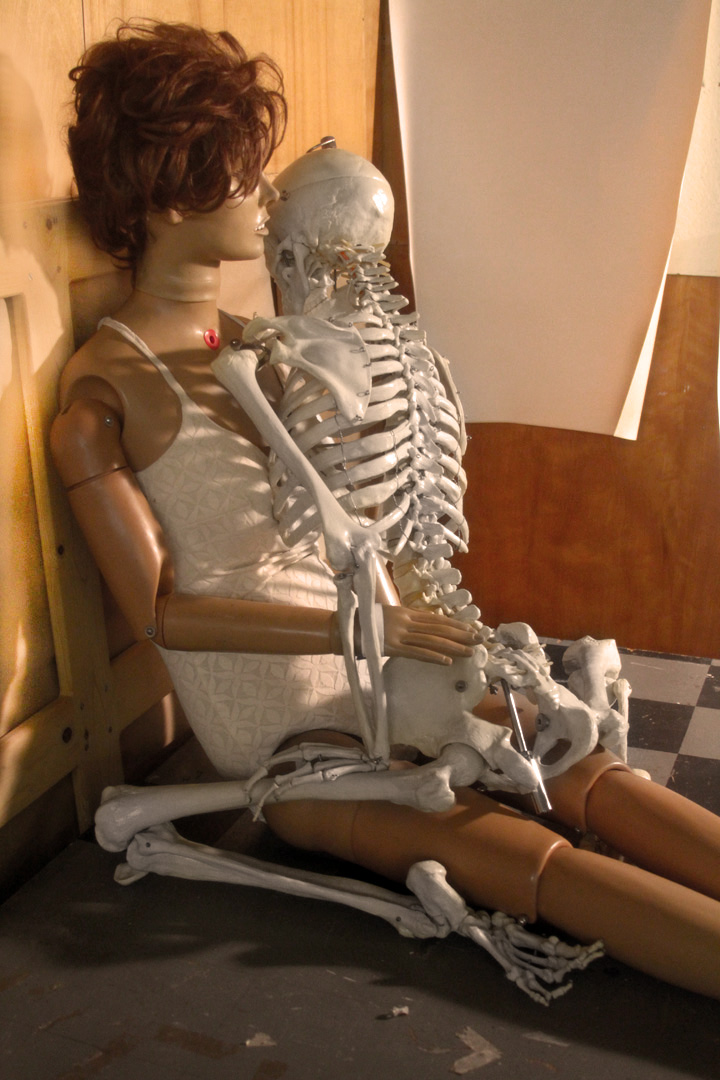
Color Studies with Skeleton and Mannequin III

And finally:


Color Studies with Skeleton and Mannequin II

Here are some more studies.


Color Studies with Skeleton and Mannequin I


 I shot these images last night to help with my drawing and color studies for my stained glass window. Some are altered in Photoshop and others I left alone. I think some are quite cinematic, some are sexy and some are just plain creepy.